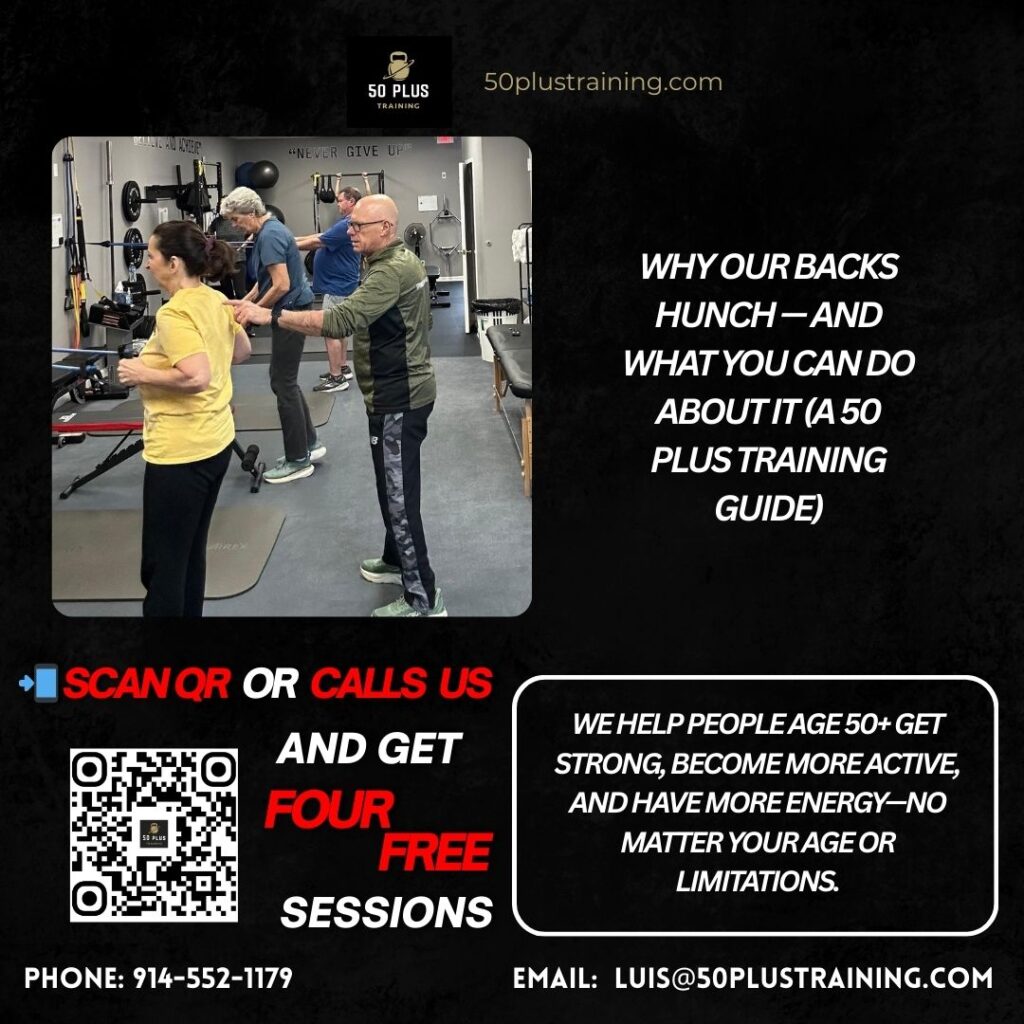
As we age, many of us start to notice subtle—but often troubling—changes in our posture. Shoulders begin to round, the head leans forward, and the upper back develops a noticeable curve. Some call it “hunchback,” “roundback,” or simply “bad posture.” In medical terms this is often due to a condition called Kyphosis (or, when pronounced, Hyperkyphosis), and it’s something we see frequently at 50 Plus Training. The Independent+2Cleveland Clinic+2
This shift in posture isn’t just cosmetic. It can lead to back pain, stiffness, decreased mobility — and even affect breathing, balance, or quality of life. But the good news? With the right awareness, habits, and training, many of the contributing factors can be prevented or managed. That’s why we want to dig into why posture changes happen, what signs to watch for, and how you can fight back — starting today.
📉 What Causes the Spine to Curve with Age
1. Changes in Bone & Spine Structure
With age, our bones — including the vertebrae in our spine — can lose density and strength. Conditions like Osteoporosis make the vertebrae more fragile, increasing the risk of tiny fractures or compression fractures. Over time, these fractures may subtly compress the vertebrae and cause the spine to bend forward. The Independent+2UPMC | Life Changing Medicine+2
Also, the discs between vertebrae — which act as shock absorbers — tend to lose hydration, elasticity, and flexibility as we age, reducing their cushioning effect and adding stress to the spine. BodyWorks Physical Therapy+1
2. Muscle Weakness & Loss of Support
Our spine relies heavily on muscles — especially the spinal extensors, upper back muscles, core, and postural muscles — to maintain an upright posture. As we age, muscle mass and strength naturally decline (a condition sometimes called Sarcopenia). Without strong support from muscles, it’s much harder to keep the spine aligned. WebMD+1
3. Poor Posture and Sedentary Lifestyle
Decades of poor posture — slouching in chairs, long hours of sitting or standing incorrectly, leaning over computers or phones — can gradually reshape your posture. This habitual slouching weakens back and core muscles and shortens chest and front shoulder muscles, pulling your posture forward. This kind, known as postural kyphosis, is often reversible with proper exercise and posture awareness. The Independent+2Consumer Reports+2
4. Combined Effects of Aging, Lifestyle, and Bone Health
For many older adults, posture changes come from a combination: weaker bones, weaker muscles, and decades of posture strains. Over time, structural changes in the spine may happen — sometimes compounded by vertebral fractures — leading to a fixed forward curve, not just reversible rounding. The Independent+2Cleveland Clinic+2
⚠️ Why It Matters (Beyond Looks)
You might think a slightly bent posture is just a cosmetic issue. But posture is fundamental to how your body functions. A pronounced curve in your upper back can:
- Cause chronic back pain, stiffness, or discomfort
- Reduce mobility and flexibility
- Make breathing and lung capacity more difficult (because the chest is compressed) The Independent+1
- Impact balance — increasing risk of falls or instability WebMD+1
- Affect posture of hips, knees, and spine further down (kinetic chain problems) Cleveland Clinic+1
- Make everyday tasks harder — reaching overhead, carrying groceries, getting up from chairs, etc.
For adults 50+, preserving posture is one of the foundations of independence, mobility, and quality of life.
✅ What Research Says — It’s Not Just About Age
You may have heard people say, “Oh, I’m just getting older — this is normal.” But interestingly, the science doesn’t always support the idea that back pain or curvature is inevitable with age. A systematic review of studies found that back pain does not necessarily increase in older age — in some cases, it even declines among the oldest people. PubMed
That suggests that much of postural decline isn’t unavoidable fate — it is influenced strongly by lifestyle, activity level, bone and muscle health, posture habits, and movement choices.
In other words: while aging is a factor, it’s not the only one — and not the main limiting factor if you take action early.
💪 How 50 Plus Training Helps — Preventing (or Improving) Posture & Back Issues
At 50 Plus Training, we design programs specifically to address the challenges adults over 50 face — including posture, spine health, strength, balance, and long-term mobility. Here’s what we focus on:
• Strengthen the Postural Muscles
We build routines that target the upper back, spinal extensors, core, glutes, hips — muscles that support posture and stabilize the spine. Strong back + core helps maintain proper alignment even as the spine changes with age.
• Emphasize Extension-Based & Posture-Friendly Movements
Instead of encouraging repetitive forward bends (which can worsen spinal curvature), we focus on extension-based movements: back extensions, rows, chest-opening stretches, posture drills. This helps balance muscle groups front-to-back.
• Balanced, Holistic Approach: Strength + Mobility + Bone Health
We advocate not only strength training but also weight-bearing activity, balance work, flexibility, and mobility — all important to keep bones strong and joints healthy. We also encourage good nutrition (calcium, vitamin D, protein) to support bone density and muscle mass.
• Functional & Real-Life Movements
Your workouts help with everyday tasks: standing tall, carrying things, getting in/out of chairs, bending, reaching — not just gym exercises. That functional focus helps you stay independent, mobile, and pain-free in daily life.
• Posture Awareness & Lifestyle Education
We help clients learn good posture habits — sitting, standing, working, walking. Small changes like posture checks, breaks from sitting, ergonomic awareness make a big difference over time.
• Consistency & Safe Progress
Progress is gradual and safe. We know what works for bodies 50+, and we guide you so you don’t push too much, too fast — reducing risk of injury or making posture problems worse.
🧠 What You Can Do Right Now — Without Waiting
You don’t need to wait until you join a program to start protecting your spine and posture today. Here are some simple, immediate actions:
- Posture Checks: When sitting or standing, try aligning ears over shoulders, shoulders over hips, and keep chest open. Use the “wall test”: stand with back against wall, see how body touches — that can help reveal posture.
- Move Often: Don’t stay slouched for long — stand up, walk a little, stretch chest and shoulders every 30–60 minutes. Consumer Reports+1
- Strengthen Key Muscles: Gentle rows, back extensions, glute bridges, core work — even at home without heavy weights — help reinforce posture muscles.
- Bone-Friendly Habits: Walk, weight-bearing movement, balanced diet with calcium and vitamin D; avoid smoking and limit excess alcohol to support bone health. The Independent+1
- Stay Active — Not Sedentary: Take walks, stay mobile, avoid long periods of inactivity (sitting, slouching).
- Seek Professional Guidance: If you notice posture changes, pain, or height loss — talk to your doctor or physical therapist. In some cases (spinal fractures, osteoporosis) professional assessment might be needed. The Independent+1
📆 What to Watch Out For — When To Get Checked
You should consider seeing a doctor or spine specialist if:
- Your upper back curve feels fixed, even when you try to stand tall. Cleveland Clinic+1
- You’ve lost several centimeters of height over time (without clear reason). The Independent+1
- You have unexplained back pain, stiffness, difficulty breathing or fatigue when standing upright. The Independent+1
- You have a diagnosis of osteoporosis, bone fragility, or had a spinal injury or fracture. UPMC | Life Changing Medicine+1
Early detection and intervention make a real difference — even structural changes can be managed or slowed with proper care and training.
🔔 Why It’s Especially Important for Adults 50+
At 50 Plus Training, we often see clients in their 50s, 60s, 70s or beyond who believe posture change is just “inevitable.” But that mindset can lead to giving up on mobility, accepting pain, or limiting activity — often before trying what can be done.
What we see instead is people regaining strength, posture, confidence, and mobility — sometimes surprising themselves. With guided training, posture awareness, and consistency, many can avoid or slow the progression of spine curvature that leads to hunched posture.
Because as the research and experts cited in The Independent article point out: age alone doesn’t have to mean pain, curvature, or decline. The Independent+1
🏋️♂️ How to Get Started (At 50 Plus Training or At Home)
If you’re ready to take control of your posture and spine health — whether you’re 50 or older — here’s how we can help at 50 Plus Training:
- Start with a posture & movement assessment — we look at how you move, where your weaknesses are, and build a custom plan.
- Begin a strength & posture training plan — focusing on upper back, core, hips, posture-correcting movements, and functional fitness.
- Commit to regular training and mobility maintenance — consistency beats intensity for posture and spine health.
- Stay educated and mindful — posture habits, bone health, lifestyle, movement, nutrition.
- Reach out if you notice pain, posture changes, or reduced mobility — early intervention is key.
✅ Final Thoughts: Posture Isn’t Destiny — It’s a Choice
Yes — as we age, there are changes that increase the risk of kyphosis and posture decline. But that doesn’t mean you’re destined to become hunched or immobile. As the article from The Independent shows, posture changes come from a mix of spinal structure, bone health, muscle strength, lifestyle, and habits — many of which are within your control. The Independent+2Healthline+2
At 50 Plus Training, we believe in giving you the tools, guidance, and support to stay upright, strong, mobile — and full of life — no matter your age.
If you’ve noticed posture changes, back discomfort, or just want to make sure your spine stays healthy as you age, get in touch. Let’s build a plan together — one rep, one posture correction, one strong back at a time.
📞 914-552-1179
📧 luis@50plustraining.com
📍 356 Downing Dr, Yorktown Heights, NY
🌐 www.50plustraining.com
Stay strong. Stand tall. Keep moving.
— The 50 Plus Training Team